Drive2Water: The Moroccan Inventor Turning Air Into Water, One Car at a Time
Moroccan inventor Dr. El Mehdi El Khattabi has built Drive2Water, a passive onboard system that turns exhaust heat and desert air into water. Tested on a vehicle and backed by a favourable patent opinion, it now heads for the Sahara.


What if a car could make its own water while it drives? That is the question behind Drive2Water, an invention from Moroccan researchers Dr. El Mehdi El Khattabi and Mourad Boutahir that turns the heat and airflow a vehicle already produces into water, with no compressor, no battery and no extra fuel.
El Khattabi is an Associate Professor at the École Normale Supérieure of Moulay Ismail University in Meknes, and the founder of Solar-ution, a startup built around green technologies. Drive2Water is his latest step in a career spent turning wasted energy into something useful, from solar desalination to passive cooling for buildings.
Université Privée de Fès (UPF) is a partner institution on the Drive2Water project.
The desert is the brief
Drive2Water is built for places where water is far away. In the Sahara, the Sahel and the Arabian deserts, temperatures can reach 50°C, humidity can fall below 20 percent, and water points can sit hundreds of kilometres from the road.
A breakdown without water in that kind of country can become a life-threatening emergency. That is the problem El Khattabi set out to solve, not by carrying more water, but by making it on board.
How it works
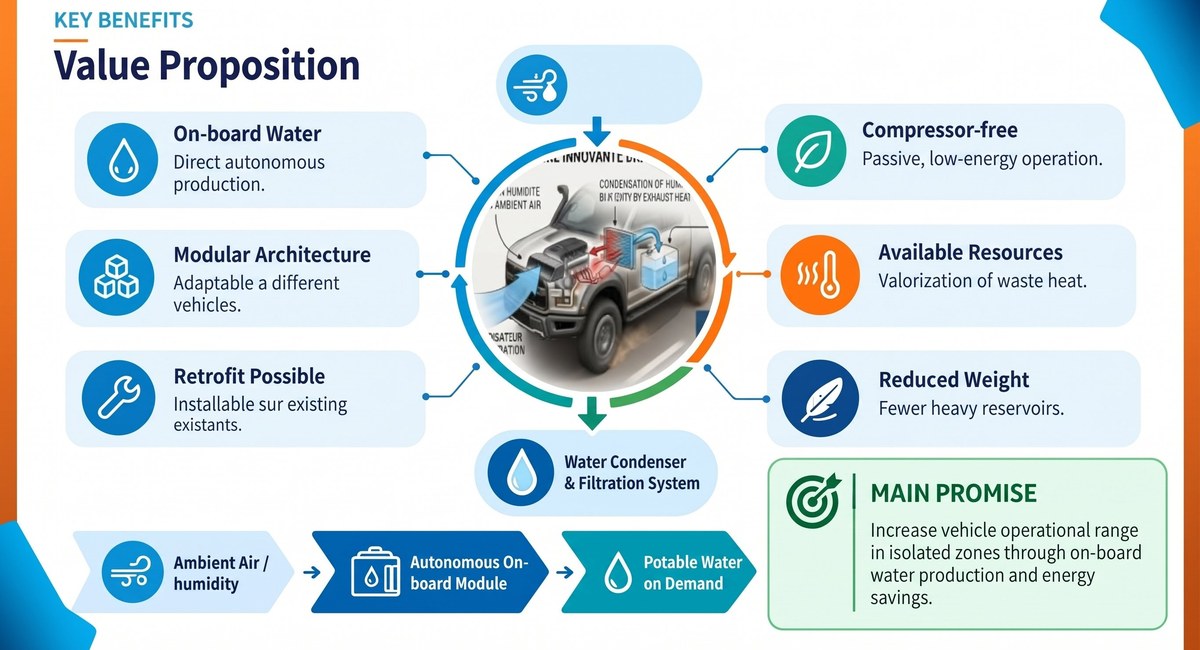
The system runs on two resources every combustion-engine vehicle already throws away. Exhaust gases leave the engine at 300 to 600°C, and the moving vehicle pushes a constant stream of air past the body.
Ambient air is drawn through a heat exchanger wrapped around the exhaust pipe, where it is heated to around 60 to 80°C. It then passes through a cooling coil exposed to the airflow of the moving vehicle, and the moisture in the air condenses.
The condensed water flows by gravity into a sealed onboard tank. The air circuit stays sealed off from the exhaust gases, and the system needs no external energy input.
The prototype carries a heat exchanger around the exhaust pipe, a finned cooling coil, a collection tank, and instruments that track temperature, airflow and water level. An adjustable air intake lets the system adapt to driving conditions.
From bench to vehicle
The prototype has been designed, built and tested on a vehicle, and the technology now sits at Technology Readiness Level 5, which means it has been validated in a relevant environment. Early vehicle tests confirmed that the concept works, that condensation happens, and that water is produced under favourable conditions.
El Khattabi has set a production target of 3 to 10 litres per hour under favourable conditions. That figure is a target to be proven in testing, not a measured rate, and the next phase is built around measuring it properly.
The water is for technical uses in its current form. Drinking water is possible only after suitable treatment, and testing the water and building that treatment is part of the work ahead.
A patent application, not a granted patent
Drive2Water is protected by a Moroccan patent application filed with OMPIC, the Moroccan Office of Industrial and Commercial Property. The application, number 72176, was filed on 8 July 2025 in the name of Moulay Ismail University, and names fellow researchers Mohammed Zouini and Mourad Boutahir as co-inventors.
On 19 June 2026, OMPIC issued a search report and patentability opinion that found claims 1 to 7 meet the tests of novelty, inventive step and industrial applicability. The report also raised formal clarity points that still need to be addressed, and the application remains under examination, so this is a patent application with a favourable preliminary opinion rather than a granted patent.
A career built on waste heat and sunlight
El Khattabi holds a PhD in building energy efficiency and has researched in France, Germany and Lithuania. His earlier work includes a hybrid solar system that desalinates water and cools at the same time, thermochromic smart windows, a passive cooling concept for buildings called KHABYA, and smart greenhouses.
In 2019 he led the Solar-ution team at Solar Decathlon Africa, where a bioclimatic solar house built in 15 days won first prize for sustainability and third place overall. The result is confirmed by the competition’s own records, which list Solar-ution third overall and led by the University of Moulay Ismail.
His work has also been recognised with the Energy Globe Award in 2020 and the Hassan II Grand Prize for the Environment in 2023, the second of them for the solar desalination and refrigeration project. He was nominated for the ENI Award in 2020, and his portfolio counts six patents.
Where it could go
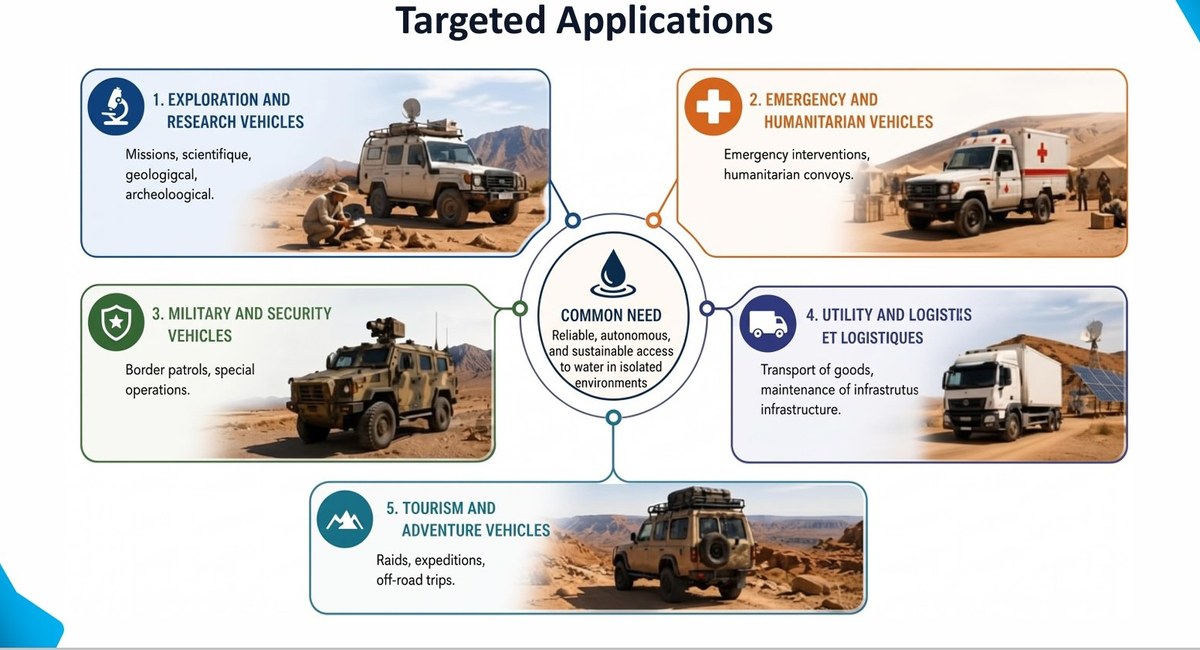
The first uses are the ones where water is hardest to reach. Exploration and research vehicles, emergency and humanitarian convoys, military and security patrols, utility and logistics trucks, and desert tourism all run where water points are scarce.
The ambition goes further. Adapting the system to Canadair-type water-bombing aircraft could give them more autonomy in remote areas during forest fires, when finding water is often the hardest part of the job.
Over the next three to five years, El Khattabi plans to optimise the system, test it extensively in the Sahara and other arid environments, and analyse the water it produces. He is looking for automotive manufacturers, equipment suppliers, off-road vehicle makers and investors to take it from prototype to industry.
Ultimately, my vision is to make water production an integrated capability of vehicles operating in environments where every litre matters.
Dr. El Mehdi El Khattabi, inventor of Drive2Water
I strongly believe that innovation emerging from countries and regions facing environmental challenges can contribute valuable solutions to global problems.
Dr. El Mehdi El Khattabi, inventor of Drive2Water



Leave a Reply