Dell Alimov Is Building Visio Into One Account for Life Across Borders
Dell Alimov founded Visio to bring international mobility into one account, starting with visas for Indonesia. The platform combines applications, document review, status updates and expiry tracking on the web and in Telegram.

Visio began with a practical question from its founder Dell Alimov: why does moving between countries still require people to navigate so many disconnected conversations, documents and deadlines? His answer is a platform that brings the whole journey into one account, starting with visas for Indonesia and Bali.
Visio Global Services FZC is registered in the UAE, and its Indonesia-focused platform Visio Bali serves travellers, families, remote workers and business visitors. The service combines online applications, document review, status updates and visa-expiry tracking on the web and in Telegram, with local delivery in Bali through partner PT Mitra Visio Group.
A Founder Who Had Lived the Problem
Dell Alimov is an entrepreneur with experience building and operating businesses across the UAE and Indonesia. Working across different markets shaped how he thinks about services, and he came to believe that the customer needs a clear process, visibility and someone accountable for helping them move forward.
Visio is the work of two founding partners who decided to build around that principle. They saw an opportunity to combine practical service delivery with technology and create a more accessible experience for people travelling, relocating or establishing a business abroad.
The starting point was the person behind the application, whether a family planning a move, a remote worker organising a longer stay or an entrepreneur exploring a new market. Each has different circumstances, yet all need to understand what to do next.
“That became the foundation of Visio: make a complicated process easier to navigate, while keeping professional support within reach.”
Dell Alimov, Founder of Visio
The Problem Was Fragmentation
The problem Dell and his co-founder identified was fragmentation. A customer might research visa options on several websites, discuss requirements through messaging apps, send documents by email and then rely on separate conversations to understand the progress of an application.
Even when individual parts of the service work well, the customer is left coordinating the whole journey. After receiving a visa, they still need to keep track of its validity and any next steps.
Indonesia became the first focus because it brings together a wide range of international visitors, from tourists and families to remote workers, business travellers and people planning longer stays. It gave the founders a clear market in which to develop a service around real customer needs.
The Whole Visa Journey in One Account
The platform brings together online applications, document submission and review, application-status updates, visa-expiry tracking and access to support. Customers can interact through the website and Telegram, giving them different ways to access the service.
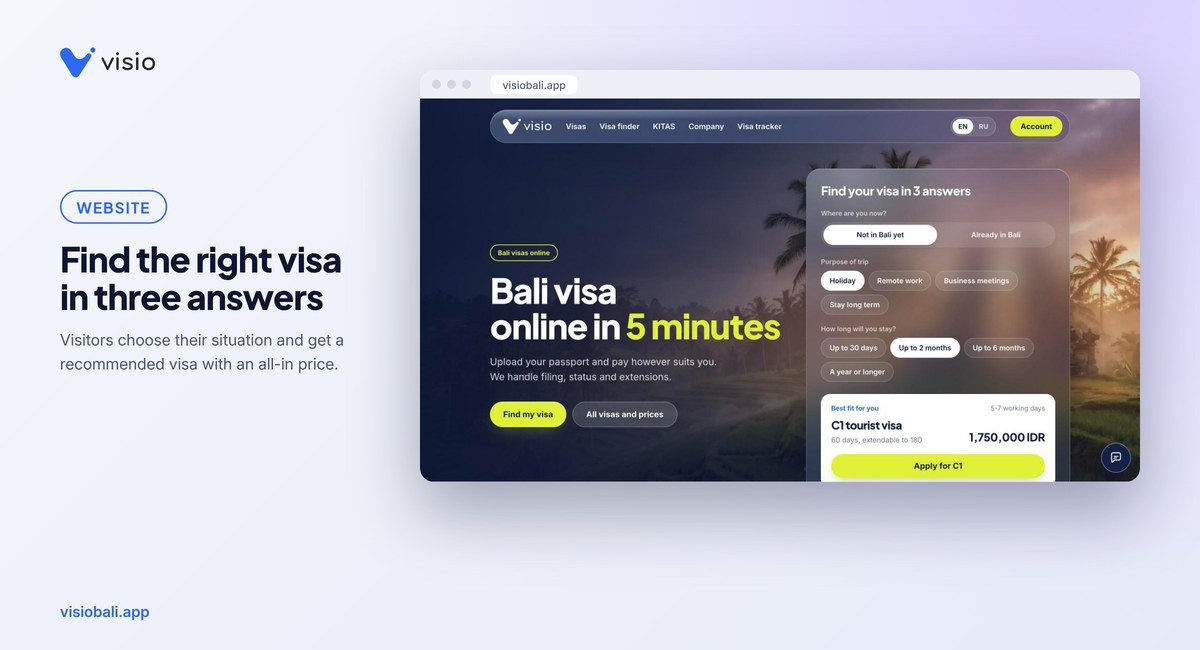
The visa finder narrows the choice to three answers, and an application takes about five minutes. The visa tracker keeps working after the application, counting down the days of stay and sending reminders in Telegram, even for visas arranged elsewhere.
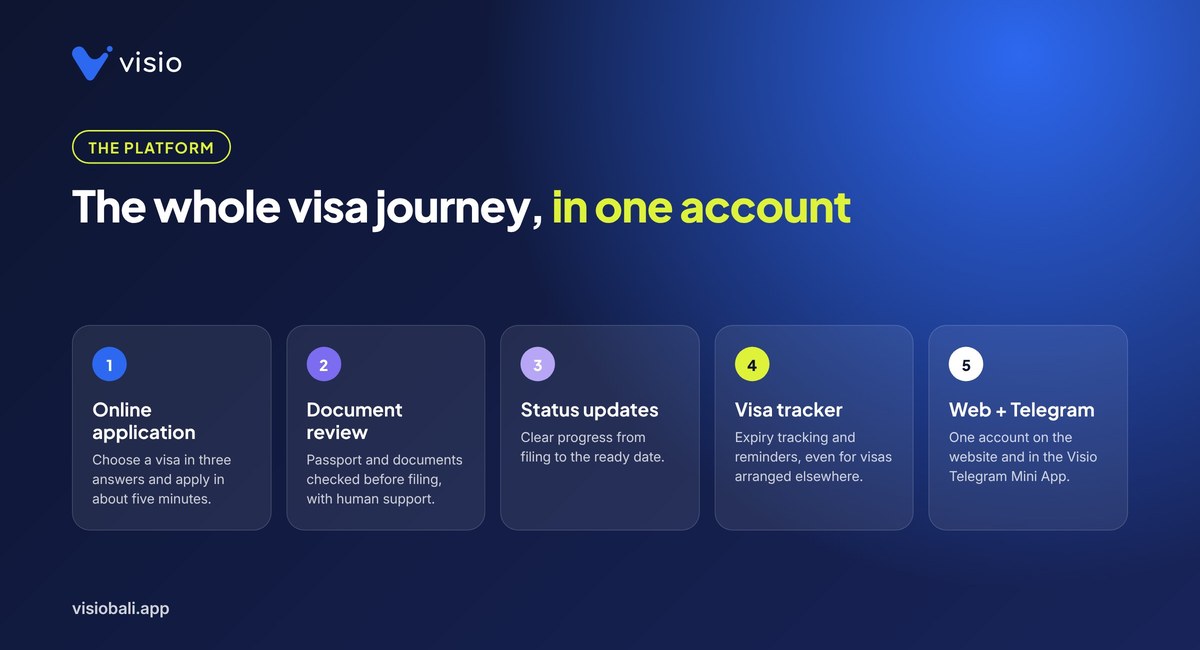
That reminder matters in Bali, where overstaying costs IDR 1,000,000 for every day. The tracker is free for any visa, including one arranged by another agent or sponsor.
For more complex needs, Visio provides specialist review for KITAS, the Indonesian stay permit, and company-setup enquiries. Visa decisions remain with Indonesian immigration, and the company is clear that no one can honestly guarantee approval.
Building Around the Customer Journey
Building the platform meant organising complexity rather than hiding it. Customers have different nationalities, travel plans and personal circumstances, so a useful platform needs to recognise when a specialist should become involved.
Another challenge was connecting the customer interface with the work happening behind the scenes. A clear application screen only creates value if the information reaches the right people and the customer understands what happens next.
That thinking also guides the approach to AI, which the team is introducing where it can reduce repetitive work and help customers navigate the process, with human review where individual circumstances require professional judgment.
What Comes Next
Indonesia is the starting market within a broader international vision. The founders intend to develop Visio into a unified platform for visa assistance, longer-term residence and related relocation and business-establishment services across multiple countries.
The goal is continuity, so that a customer planning a trip today can later use the same account for an extension, a residence option or support establishing a company. As their plans change, Visio aims to remain a useful place to manage the next step.
Planned AI capabilities include guided onboarding based on nationality, destination, purpose and length of stay, personalised document checklists, help extracting information from documents, multilingual guidance and proactive deadline reminders. Complex enquiries would still route to the appropriate local specialist.
Over the next three to five years, the ambition is to make Visio a trusted platform that people return to as their lives and businesses become more international. The impact the founders want is practical: less time repeating information, fewer avoidable document errors, clearer next steps and greater confidence when planning a move abroad.
Why Continuity Is the Bet
We read Visio’s bet as continuity rather than any single visa product. A traveller who finds the platform for a 30-day trip is the same person who later needs an extension, a stay permit or a company, and each step is easier when the account already holds their documents and history.
The risk is the one every cross-border service faces, since each new country needs local knowledge, partners and processes that cannot be copied from Bali. Visio’s answer is to expand market by market, which is slower than a pure software rollout but matches how immigration actually works.




Leave a Reply