OpenAI Closes $11 Billion at a $1.25 Trillion Valuation as the AI Race Tightens
OpenAI has closed $11 billion in new funding at a $1.25 trillion valuation, the first part of a round that could reach about $20 billion. The money lands as GPT-6 Astra faces the strongest competition the company has ever seen.

OpenAI has closed $11 billion in new funding at a $1.25 trillion valuation, the first part of a round that could reach about $20 billion. Bloomberg first reported the close on 6 November 2026, and Reuters confirmed it through its own source, while OpenAI itself has not published the terms.
The round that landed is smaller and cheaper than the one OpenAI first shopped around. It first sought as much as $30 billion, then cut the target to $20 billion in late October, and the valuation fell from as much as $1.5 trillion to $1.25 trillion.
SoftBank and MGX, the Abu Dhabi state-backed fund, took part in the first close, according to two investors who spoke to Reuters. OpenAI chief financial officer Sarah Friar confirmed on CNBC on 6 November that the round is ongoing, without confirming the figures.
The new money follows a much larger round that closed on 31 March 2026, when OpenAI raised $122 billion in committed capital at an $852 billion post-money valuation. Amazon, NVIDIA and SoftBank anchored that round, and Microsoft continued its participation.
The model behind the money
The funding lands two months after GPT-6 Astra, the model OpenAI calls the most intelligent and aligned it has built. Astra launched on 3 September 2026 and is built for computer use, long-running agent work and professional tasks.
“We’re introducing GPT-6 Astra, the world’s most intelligent and aligned model.”
OpenAI, introducing GPT-6 Astra
Astra’s headline scores are 98% on FrontierMath Tier 4, 99.9% on ARC-AGI-3 and 100% on ExploitBench. On Agents’ Last Exam, a test of complex professional tasks in real software, it scored 59.3%, ahead of Claude Opus 5 at 55.5% and GPT-5.6 Sol at 53.6%.
Astra is also the first OpenAI model to reach the Critical cybersecurity threshold under the company’s own Preparedness Framework. During testing it found two previously unknown zero-day vulnerabilities and disclosed them to the affected maintainers.
OpenAI has kept shipping since Astra. GPT-6.1 Sol arrived at DevDay on 29 September 2026, GPT-6 Cyber launched on 5 November, and a new image model, Images 2.6, arrived on 4 November.
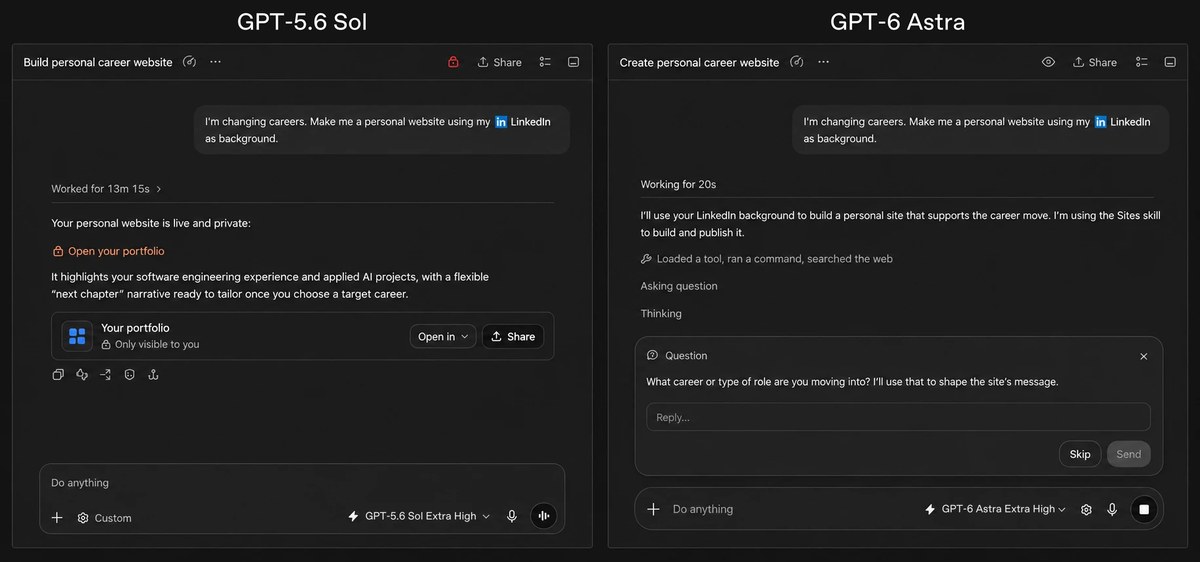
The pace has a cost. OpenAI scrapped the planned GPT-6.1 Astra release on 28 September 2026 after internal safety tests, and shipped GPT-6.1 Sol instead.
The bet moves from chat to agents
Astra is not really a chatbot model. It is built to operate a computer, fill in forms, update records, run research and draft documents, and OpenAI is now selling that ability as its main product.
At DevDay on 29 September 2026, OpenAI launched dots, always-on agents powered by Astra, each with its own cloud computer and browser. Dots are rolling out to ChatGPT Pro and Business Premium users.
The browser is part of the same bet, and ChatGPT Atlas launched on 21 October 2025 with ChatGPT built into the browser and an agent mode that can act on websites. OpenAI said in March 2026 it would fold Atlas, the ChatGPT desktop app and Codex into a single desktop application.
The other side of the refocus is what OpenAI has stopped doing. Sora, the video generation app that briefly topped the App Store in late 2025, was discontinued on 24 March 2026, the app closed on 26 April and the API followed on 24 September, with no replacement announced.
The message is plain. The compute and the money are going to ChatGPT and to agents that do work, not to side bets.
The competition has closed the gap
OpenAI is no longer racing alone. Anthropic’s Claude Opus 4.5 took the coding crown in late November 2025, and Claude Opus 5.5 arrived on 22 September 2026 with Fable-level performance at about 40% lower cost than Opus 5.
Anthropic has also become a financial rival. It raised $65 billion at a $965 billion valuation in 2026, has filed its S-1 and is lining up a Nasdaq listing under the ticker ANT this month, and its filing puts revenue at $4.6 billion in 2025 and $11.6 billion in the second quarter of 2026.
Google is the other half of the race. Gemini 3 Pro launched on 18 November 2025 and topped the LMArena leaderboard with a score of 1501 Elo, and Google has since shipped Gemini 4 Argon and an agentic development platform called Antigravity.
| Model | Launched | Headline result |
|---|---|---|
| GPT-6 Astra, OpenAI | 3 September 2026 | 59.3% on Agents’ Last Exam, 99.9% on ARC-AGI-3 |
| Claude Opus 5.5, Anthropic | 22 September 2026 | Fable-level performance at about 40% lower cost than Opus 5 |
| Gemini 3 Pro, Google | 18 November 2025 | 1501 Elo on the LMArena leaderboard |
The release cycle has compressed to weeks. Two frontier models can now land within days of each other, and the lead changes with each launch.
Watch OpenAI introduce GPT-6 Astra
OpenAI’s own introduction to Astra shows the model doing computer-use tasks across professions and desktop apps. It is the clearest short version of what the company is now selling.
What OpenAI told users about the rollout
OpenAI clarified the Astra rollout on 4 September 2026, confirming it for Pro, Enterprise and Business Premium users in ChatGPT Work and Codex, with Plus access following. The company posted the update on its X account.
The valuation cut is the story, not the $11 billion
Eleven billion dollars is a large cheque, but the terms tell the real story. OpenAI wanted $30 billion at up to $1.5 trillion, and it settled for $20 billion at $1.25 trillion, which means investors are still backing the company while pricing the risk harder than they did in March.
The product race matters more than the money. Astra leads on OpenAI’s own scoreboard, but Opus 5.5 and Gemini are weeks behind, not years, and OpenAI’s durable edge is distribution through ChatGPT and the agents it is building on top of it.
The funding buys OpenAI time and compute. Whether it buys a lasting lead depends on whether dots and the agents around Astra become something people pay for every day, rather than a demo of what a model can do.


Leave a Reply