Quick Commerce in the UAE 2026: Players, Growth, Rules and What Comes Next
Quick commerce in the UAE has grown up fast. This guide covers the players, the real market size, the technology behind 15-minute delivery, the new rules arriving in 2027 and what comes next.

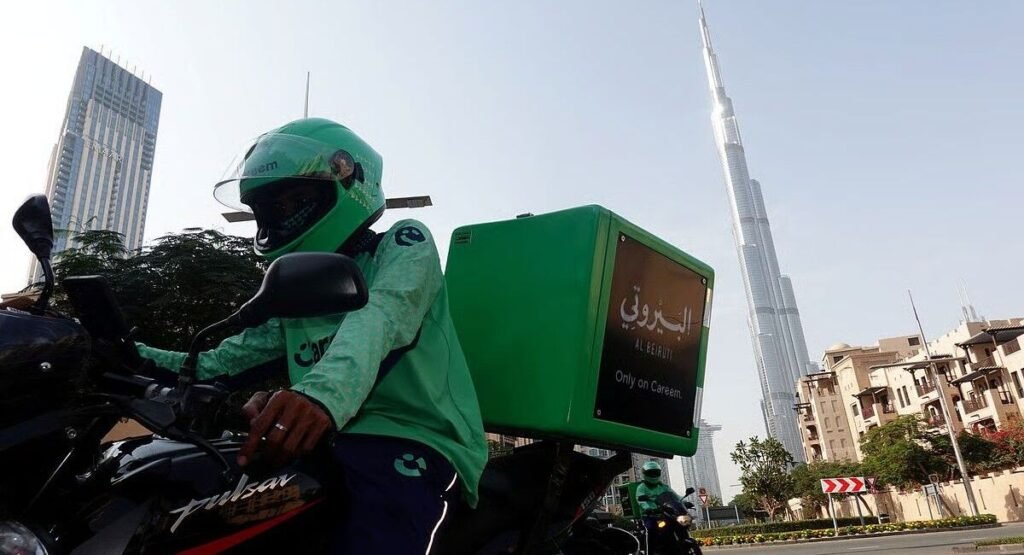
Order groceries on your phone in Dubai today and they can be at your door in 15 minutes, sometimes faster. What started as a pandemic habit has become one of the most competitive corners of the UAE economy, with listed giants, super-apps and drone pilots all fighting for the same kitchen drawer.
Our team took a deep look at the sector, researching the key players and how they differ, the real size of the market, and the technology that makes 15 minutes possible. We also tracked the new rules arriving in 2027 and what comes next for a sector that is growing up fast.
How big is quick commerce in the UAE
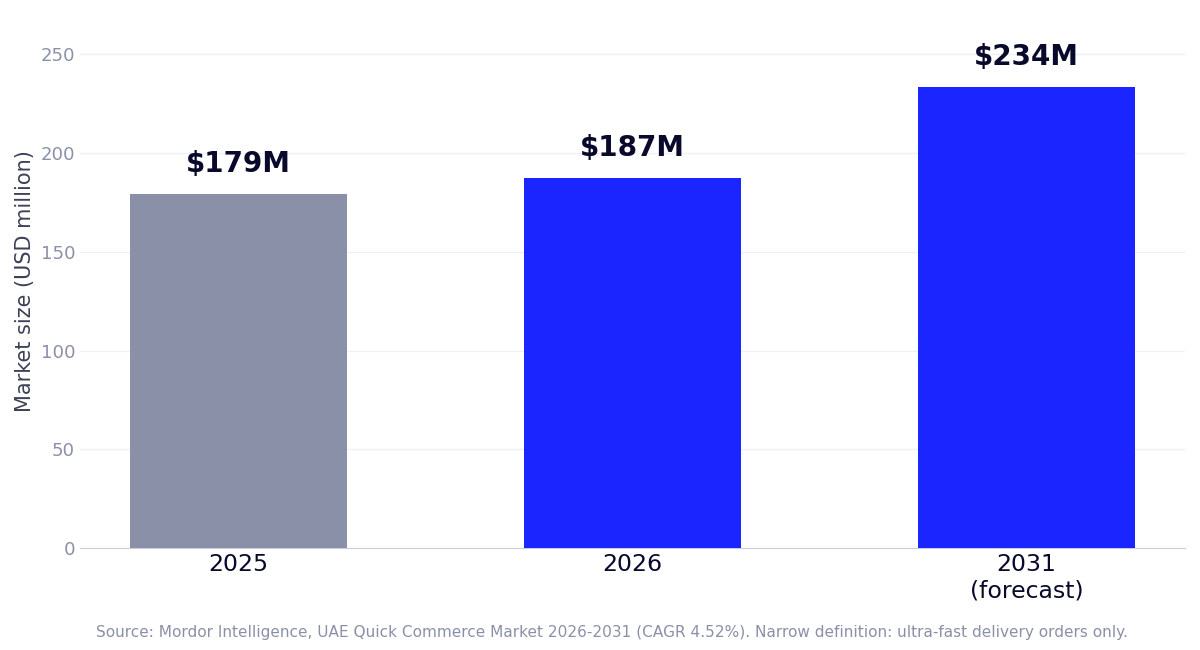
Ask two research firms and you get two very different answers. Mordor Intelligence puts the UAE quick commerce market at $187.41 million in 2026, growing to $233.78 million by 2031 at a 4.52 percent annual rate. ResearchAndMarkets puts the same market at $1.38 billion in 2025, rising to $1.86 billion by 2029.
The gap is about definitions, not disagreement. The smaller figure counts only ultra-fast delivery orders through digital channels, while the larger one counts the broader value of goods ordered for rapid delivery, so both can be right at once. What both agree on is the direction, steady growth at single-digit rates after the explosive pandemic years.
Zoom out and the context is a booming online economy. Mordor Intelligence puts UAE ecommerce revenue at $12.30 billion in 2026, on its way to $21.01 billion by 2031, with Dubai accounting for roughly 60 percent of the market. Food and beverage is the fastest-growing ecommerce category at 13.16 percent a year, which is quick commerce doing its work.
Grocery and staples still dominate quick commerce itself, with about 51 percent of revenue in 2025. Fresh produce and dairy is the fastest-growing category at 5.49 percent a year, and the 11 to 30 minute delivery window takes the largest share of orders at nearly 55 percent. The sub-10 minute promise is the fastest-growing slice, but it remains a minority of the market.
The key players
Six names matter in the UAE, and they run three different models. Dark store operators own the stock and the shelves, marketplaces connect shoppers to existing stores, and super-apps bolt grocery delivery onto a much bigger bundle.
| Player | Model | Delivery promise | What stands out |
|---|---|---|---|
| Talabat Mart | Dark stores, about 160 across the region | Under 20 minutes in dense areas | Part of the DFM-listed Talabat group, with InstaShop and Local Shops alongside |
| Noon Minutes | Compact dark stores, 12 in Dubai and Sharjah | 10 to 15 minutes in selected areas | Delivery hubs inside ADNOC fuel stations, plus the Noon One subscription |
| Careem Quik | Super-app with partner stores | Within minutes, location dependent | Careem Plus bundles delivery with rides, and Quik Electronics delivers gadgets in 60 minutes |
| InstaShop | Multi-retailer marketplace | Under 30 minutes, varies by store | Now a Talabat subsidiary, still run as an independent brand, with $631 million in 2024 GMV |
| Carrefour | Supermarket branches as fulfilment hubs | Around 60 minutes | Operated by Majid Al Futtaim, using existing stores instead of building dark ones |
| Deliveroo | Restaurant and grocery marketplace | Varies by restaurant and store | Deliveroo Plus subscription locks in regulars with free delivery |
Talabat: the listed giant
Talabat is the company the whole market is measured against. It listed on the Dubai Financial Market on 10 December 2024, raising about AED 7.5 billion in the largest global technology IPO of that year and the first ever technology listing on the DFM.
The group keeps consolidating. In February 2025 Talabat completed its $32 million acquisition of InstaShop from its parent Delivery Hero, bringing the marketplace in-house while keeping it as an independent brand. The price was largely symbolic for an intra-group transfer, since Delivery Hero had paid up to $360 million for InstaShop in 2020, but the effect is real, with combined grocery and retail GMV above $2.5 billion in 2024.
Noon: the local challenger
Noon is the homegrown answer, built on its own ecommerce and logistics backbone. Noon Minutes runs compact dark stores for 15-minute delivery, and its 2025 move into delivery hubs inside ADNOC fuel stations shows how creative the fight for dense locations has become.
Noon One, its subscription, bundles free delivery across the group. That matters because the battle has shifted from who is fastest to who keeps the customer coming back without paying for every order with a discount.
Careem: the super-app play

Careem plays a different game. Grocery delivery sits inside an app that also moves people, so Careem Plus can bundle rides, food and shops into one subscription. Its Quik Electronics service, promising gadgets in 60 minutes, shows how quick commerce is spreading beyond the weekly shop.
The technology behind the 15-minute promise
Speed is a real estate problem before it is a software problem. Dark stores only work above a density threshold of roughly 150 to 200 orders a day, which is why Noon Minutes placed its 12 stores in areas seeing more than 200 transactions per square kilometre per day.
Inside the store, the technology is micro-fulfilment: tight ranges chosen for the neighbourhood, real-time stock, and pickers who assemble an order in minutes. Outside, routing software, live rider tracking and packaging built for 15-minute handling do the rest.
Payments have gone almost fully digital. Talabat and Noon processed 78 percent of 2025 orders through Apple Pay, Samsung Pay or local wallets, which removes cash handling from the fastest part of the chain entirely.
Drones are moving from demo to service
The most eye-catching technology is already flying. Keeta Drone, a subsidiary of China’s Meituan, launched the first phase of Dubai drone delivery in Dubai Silicon Oasis in December 2024, with six drones authorised by the Dubai Civil Aviation Authority to carry medicine and parcels.
The programme has grown quickly since. Dubai Municipality partnered with Keeta Drone in May 2026 to bring drone delivery to selected parks and beaches, with pilot trials expected later in 2026, and Sobha Realty signed a deal the same month to offer drone deliveries across its communities. Keeta Drone says it had completed more than 880,000 deliveries by March 2026 across Shenzhen, Hong Kong and Dubai.
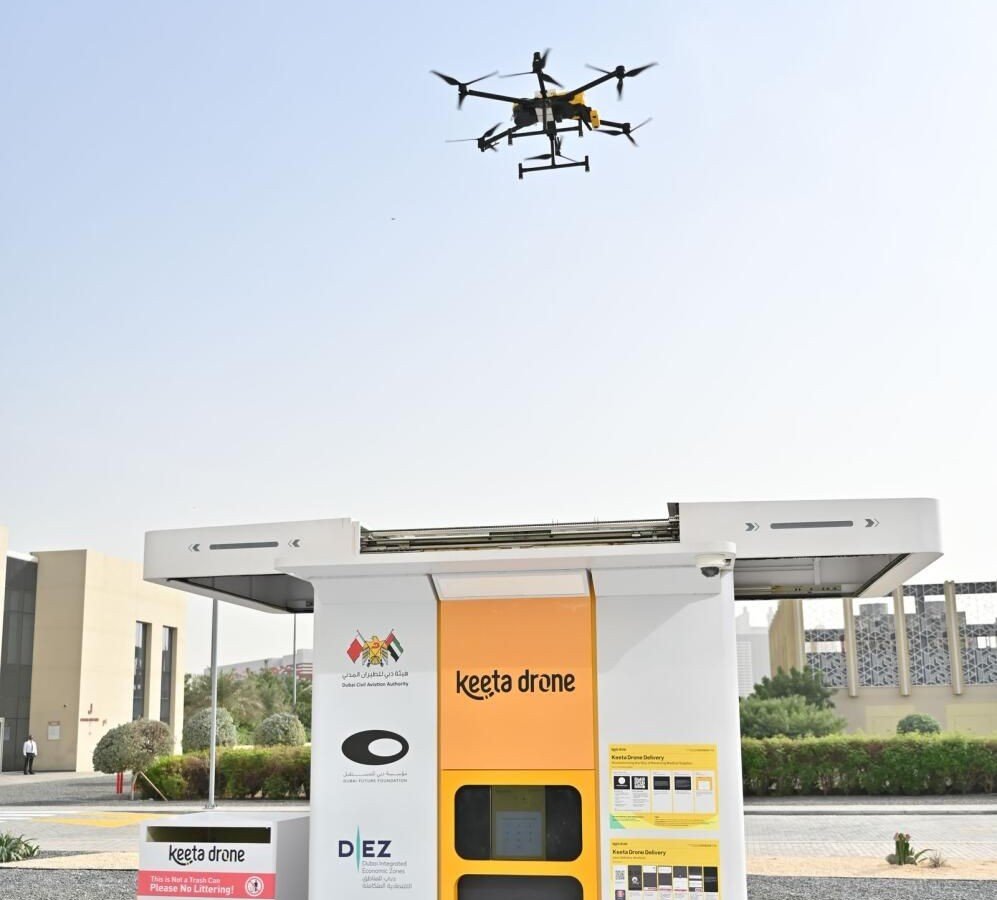
Keeta Drone is launching its newest delivery drone, the M-Drone 4L, at Dubai Future Week from 18 to 21 November 2026. The company says the new drone can deliver straight to homes as well as to parks and beaches, which would take the service beyond fixed stations for the first time.
Heavier cargo is coming too, just more slowly. Aramex and DHL Express have both signed agreements with LODD Autonomous to test its Hili hybrid cargo aircraft, a 250 kilogram payload drone with a 700 kilometre range, on hub-to-hub routes. Validation trials run from late 2026 into late 2027, so this is middle-mile infrastructure for the future rather than a service customers will use this year.
The rules are catching up, and that is good news
Quick commerce in the UAE is getting its rulebook, and the timing tells its own story. The government is formalising the sector just as it matures, which gives platforms, riders and customers something the early years never had: certainty.
The biggest change lands on 1 January 2027, when Cabinet Decision No. 174 of 2026 takes effect as the executive regulation of Federal Decree-Law No. 14 of 2024 on traffic. Under Article 10, delivery riders must stop carrying orders in backpacks and use approved loading equipment instead, and no passenger may ride behind a rider on a delivery motorcycle.
The same decision requires riders to wear the prescribed uniform, carry a valid professional permit and use approved systems installed in their vehicles. Professional permits run for two years, and Article 7 caps driving at nine hours in any 24-hour period while banning driving while fatigued.
Dubai has been tightening its own rules in parallel. Since 1 November 2025, delivery bikes may not use the two left lanes on roads with five or more lanes, or the left lane on roads with three or four, with fines of AED 500 for a first offence and AED 700 for a second. The RTA is also rolling out smart monitoring of delivery bikes, optional until mid-2027 and mandatory after that, using cameras and sensors to track speed, location and riding behaviour.
The licensing bar is already high. A Dubai delivery rider needs a UAE licence, a good-conduct certificate, RTA training and an RTA permit, must be between 21 and 55, and must hold residency sponsored by the delivery company or a licensed labour supplier. Bikes must be GCC specification, 100 to 200cc, registered in Dubai and no more than four years old, with an optional inspection introduced in February 2026 allowing a fifth year.
Other emirates are moving the same way. Abu Dhabi has barred delivery bikes from roads with speed limits of 120 km/h or more since 15 May 2026 and has required yellow plates on commercial motorcycles since January 2025. Sharjah set dedicated lanes for motorcycles, delivery bikes included, from 1 November 2025.
Summer brings its own protections. The midday break runs from 15 June to 15 September, 12:30 to 3pm, during which riders cannot be made to work and take at most three orders within 60 minutes. RoadSafetyUAE has welcomed the new federal rules while calling for clearer guidance on designated riding areas, which is the honest next step.
What comes next
The subsidy era is ending. Talabat’s customer-acquisition costs rose 25 percent year on year as first-order subsidies climbed to AED 40, which is why every major player now sells a subscription instead: Talabat Pro at AED 19 a month, Noon One and Careem Plus. The winner will be whoever keeps customers without buying each order.
Ownership is shifting too. Uber agreed in July 2026 to acquire Delivery Hero, Talabat’s parent, with the deal expected to close in the second half of 2027. Talabat has said the deal will not change its DFM listing, management or strategy, but a new ultimate owner always bears watching.
Geography is the next frontier. Dubai holds about 60 percent of UAE ecommerce, Abu Dhabi is closing the gap, and the northern emirates together generate under 15 percent of volume. The platforms that crack affordable density outside the two big cities will find the growth the centre no longer offers.
Categories will keep widening. Fresh produce and dairy is already the fastest-growing quick commerce category, and electronics, pharmacy and everyday retail are following the same path from scheduled delivery to instant. The 15-minute promise is becoming the default expectation, not the premium option.
And the sky is opening. If the Keeta Drone pilots at parks, beaches and Sobha communities work through 2026, drones will stop being a demonstration and start being a delivery channel. The UAE has the regulation, the airspace framework and the willing partners, which is more than most markets can say.
Put it together and the outlook is genuinely positive. Quick commerce in the UAE has moved from a race to be fastest into a contest to be the most reliable, the best run and the most trusted. With clear rules, deep-pocketed platforms and technology that keeps arriving early, the country has a credible shot at running the most advanced 15-minute market in the world.




Leave a Reply