Oman’s ExxonMobil Deal Points to a Second LNG Hub at Duqm
Oman signed a gas concession with ExxonMobil on 19 November. The real story is the LNG plant it could unlock at Duqm, and what that means for Oman's gas future.

Oman signed a gas deal with ExxonMobil on 19 November that looks, at first glance, like a routine concession. The interesting part is not the $400 million at the top of it.
The deal covers gas already discovered in the Greater Makarem area, known as Block 20. It is linked to a proposed LNG plant at Duqm with a target capacity of 6 to 9 million tonnes a year, which would add more than half to Oman’s current LNG capacity.
What the deal actually covers
The agreement is a concession to appraise and develop the gas, signed by the government with Energy Development Oman and ExxonMobil. Initial investment is expected to exceed $400 million, and total investment across the development and production phases is expected to reach several billion dollars.
Appraisal comes first. The partners will run technical studies and drill appraisal wells to establish how much gas the field can produce, and the results will set the target production volume and the infrastructure the field needs.
That makes this a beginning, not a finish. No appraisal timetable, partner shares, operator or production date has been disclosed, and the LNG plant itself is a proposal, not a decision.
Why Duqm, and why now
Oman’s existing LNG plant at Qalhat, near Sur, runs three trains with a nameplate capacity of 10.4 million tonnes a year. Debottlenecking lifted that to 11.4 million tonnes, and the plant produced a record 12 million tonnes in 2024.
Sur is, in other words, full. A fourth train at Sur, with a planned capacity of 3.8 million tonnes a year, is under deliberation and still awaits a final investment decision.
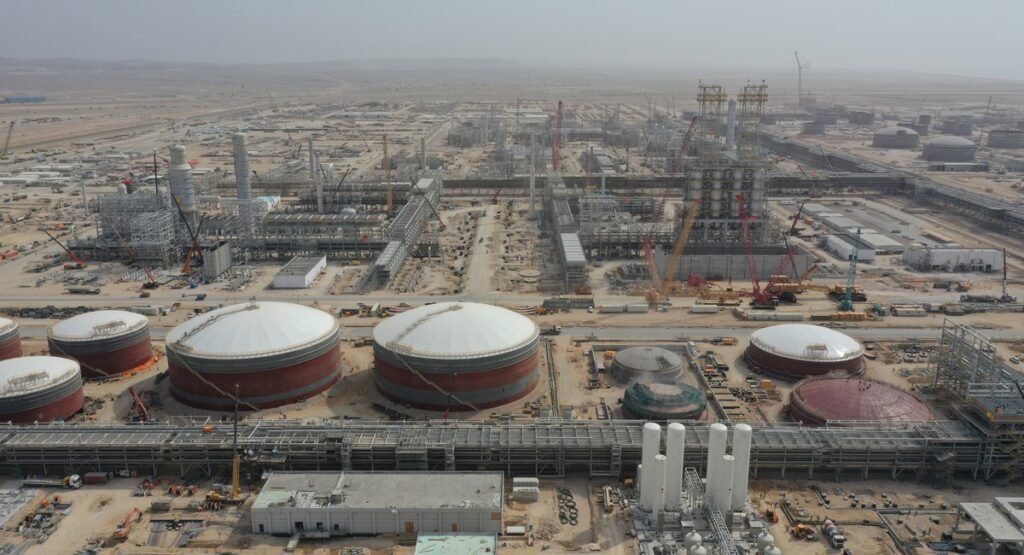
Duqm is the alternative coast. The Special Economic Zone there already hosts the OQ8 refinery, a $9 billion joint venture between OQ and Kuwait Petroleum International that was inaugurated in February 2024 and built with a capacity of 230,000 barrels a day.
An LNG plant at Duqm would give Oman a second export point for gas, with its own port and industrial base. The ministry says the project would also draw investment into gas infrastructure, processing and export facilities at Duqm.
What ExxonMobil brings to a difficult field
Greater Makarem was formerly the northern part of BP’s Block 61 tight gas development. Tight gas sits in rock that gives up its gas reluctantly, and producing it takes horizontal drilling and hydraulic fracturing at scale.
That is the context for ExxonMobil’s arrival. The ministry said the company’s entry reflects the sector’s appeal to major global companies, and pointed to its expertise in exploration and production from complex and challenging reservoirs.
ExxonMobil is entering Oman’s oil and gas sector for the first time. Its partnership with Energy Development Oman pairs the state company’s local position with one of the world’s biggest energy companies, and the ministry expects the pairing to bring technology transfer and training for Omani engineers.
What is still unknown
Almost everything that would let you put a date on this. The announcement gives no length for the appraisal period, no date for a final investment decision, and no cost, owner or start date for the Duqm plant.
The 6 to 9 million tonnes is a target, and the ministry says it could be set higher depending on what the appraisal finds. Until the wells are drilled, the size of the prize is an estimate.
That is normal for a concession of this kind. It is also the reason to read the several billion dollar figure as an ambition rather than a commitment.
The bet Oman is making
Oman is betting that gas stays valuable for decades, and that Duqm can become a second energy coast alongside Sur. The refinery proved the zone can host world-scale energy projects, and an LNG plant would deepen that bet considerably.
The open question is sequencing. Sur’s fourth train and a new Duqm plant would both need gas, capital and buyers, and Oman has not said which comes first or whether both proceed.
What to watch now is the appraisal programme. The wells will decide how much gas Block 20 holds, and that number will decide whether Duqm gets its LNG plant.



Leave a Reply