Dubai Startup Flashmind’s Tiny Forecasting Models Beat Google and Datadog on Global Benchmarks
Flashmind, a Dubai startup with a team of around eight people, has built a family of forecasting models that top two global benchmarks. Its largest model has 119 million parameters, yet it outperforms rivals more than 20 times its size.


A Dubai startup with a team of around eight people has built forecasting models that sit at the top of two global benchmarks. Flashmind introduced PDM, its family of three time-series models, on 1 November, and its largest model now ranks first among zero-shot foundation models on both GIFT-Eval and TIME.
The result that turns heads is the size of the models doing the beating. PDM-Nano, the largest of the three, has 119 million parameters, yet it outperforms Datadog’s Toto, a model with roughly 21 times as many.
Small models, top scores
PDM is a family of forecasting foundation models that predict future values from past data, from shop demand to energy use and sensor readings. The three models share one custom architecture and differ only in capacity, with Nano at 119 million parameters, Pico at 32.2 million and Femto at 6.18 million.
They work zero-shot, which means they forecast new data without the user training a model first. On GIFT-Eval, Nano scored 0.637 on normalized MASE, and on TIME it scored 0.625, leading the zero-shot foundation models on both.
Both benchmarks’ maintainers independently reproduced the results for all three models before merging Flashmind’s submissions. The evaluations covered 97 GIFT-Eval configurations, 98 TIME configurations and 100 tasks on a third benchmark, fev-bench.

The size gap is the story
The most striking comparisons sit at the small end of the family. Femto, with just 6.18 million parameters, beats Google’s TimesFM-2.5, a model about 37 times its size, on both normalized MASE and CRPS on GIFT-Eval.
Pico, at 32.2 million parameters, beats Mistral AI’s Timestral-209M with 6.5 times fewer parameters on the same two measures. Nano beats Datadog’s Toto-2.0-2.5B on normalized MASE across both benchmarks, despite Toto having about 21 times as many parameters.
The lead is not absolute. Timestral-209M keeps a small advantage on TIME’s CRPS measure and on the two fev-bench skill scores, and TIME’s overall top entry is TimeRSI-1.5, an adapted system built around frozen foundation-model weights rather than a foundation model itself.
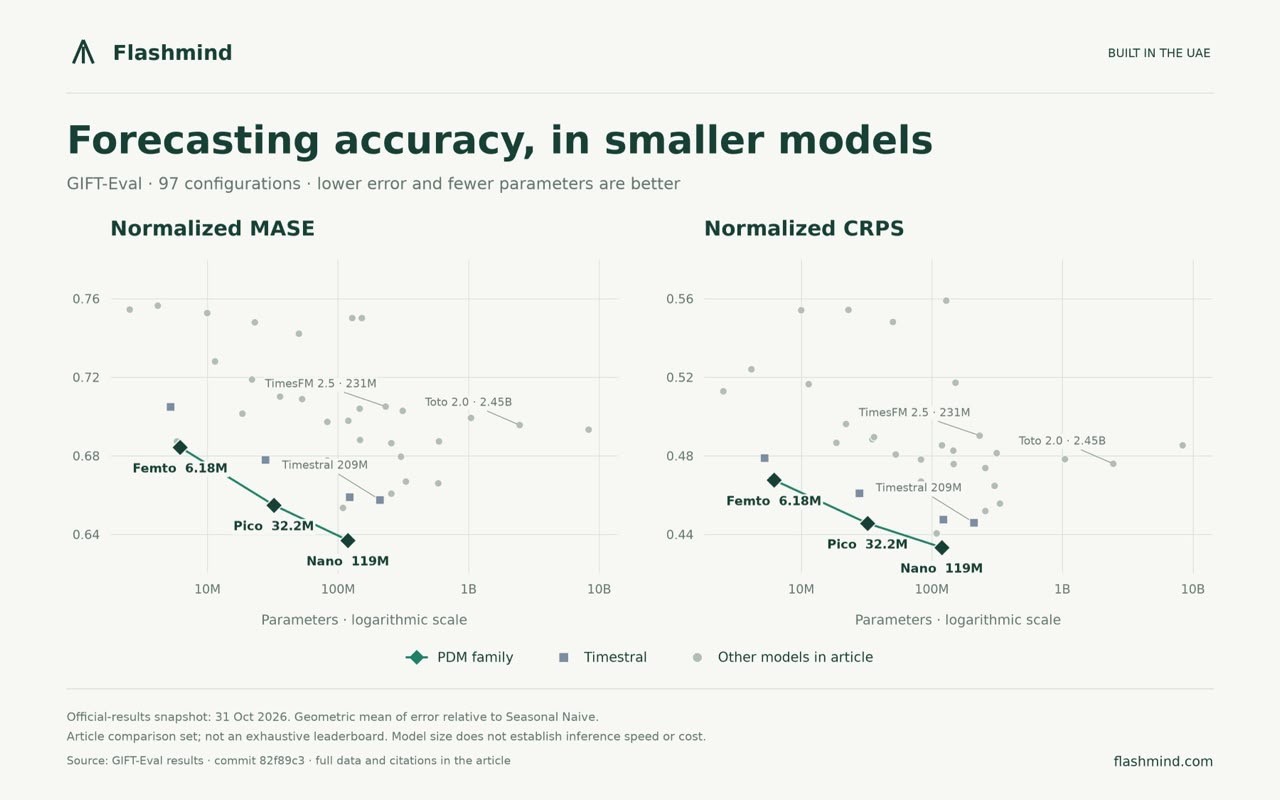
Across the 97 GIFT-Eval configurations, each PDM model records lower error than the other models shown with the same or fewer parameters. That puts the family on the accuracy-size frontier of this comparison, though Flashmind notes that model size alone does not establish inference speed or cost.
From trading floors to forecasting
Flashmind grew out of Infinite Field, where the founders spent years building predictive models for high-frequency trading. The company was started to put that work on prediction to use beyond financial markets.
The founders, Moses and Duco, run the company jointly. Their trading background shaped how they think about forecasting, where a wrong prediction carries a real cost.
In trading, predictions guide decisions involving real money, so understanding uncertainty matters as much as estimating what comes next. The same need shows up far from trading, from planning inventory to managing energy demand.
Flashmind already uses PDM in its own trading strategies, and says it is seeing interest from companies in financial services and payments infrastructure. The aim is to make strong forecasting available to organisations without them needing to build their own research team.
Built in Dubai
Flashmind is based at the Dubai AI Campus in DIFC, where it also colocates the dedicated hardware it uses to train its models. Owning the hardware lets the team control how it configures machines, schedules experiments and uses capacity, without depending on GPU rental availability and pricing.
The team numbers around eight people, most of them based in Dubai with colleagues in Belgrade, Serbia. The company is bootstrapped, and its careers page lists openings in machine learning research and engineering.

All three models are available free through the company’s API, with a free account covering 10,000 forecast calls a month. A technical report is on the way, and the next suite of PDM models is already in development.
Accuracy is the entry ticket, not the business
Topping a benchmark is a research result, and Flashmind has been careful to publish the full picture, including the measures where rivals still lead. The harder test is commercial, turning free API users and early interest from financial services into a business that pays for its own hardware and research.
Being bootstrapped gives the company room to take that test on its own schedule. If the next suite of models holds the same accuracy-size edge, a small Dubai team will have built something the largest labs have not, forecasting models that win by being smaller.



Leave a Reply