Andrea Pivetta Has Spent Forty Years Turning Sound Into Sculptures That Move
Andrea Pivetta has spent more than forty years turning sound into sculpture in his atelier near Vicenza, Italy. His kinetic amplifiers, from Opera One to Opera Only and SILENTE, treat engineering as art.

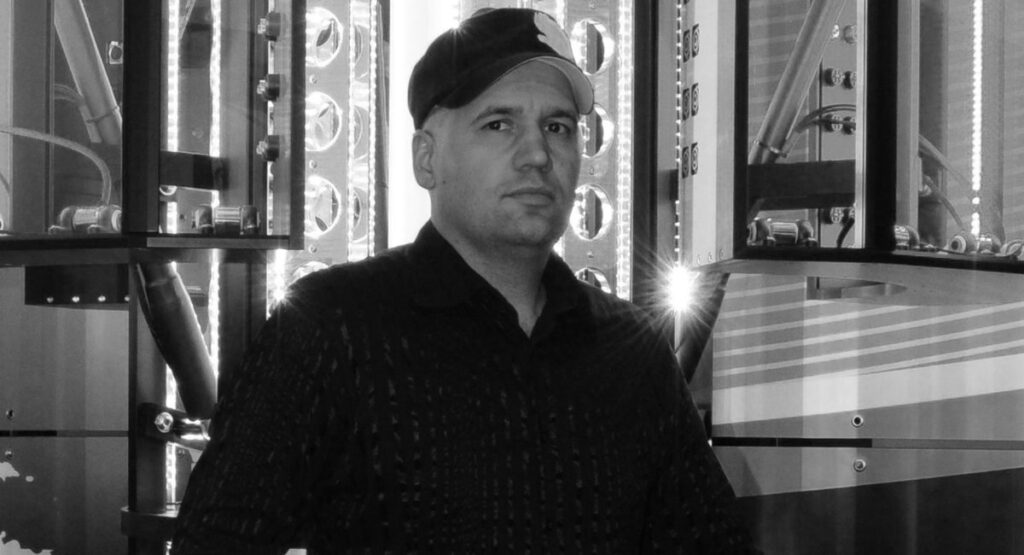
Andrea Pivetta is an Italian designer and inventor who has spent more than forty years turning sound into sculpture. From his independent atelier near Vicenza, Italy, he develops every creation himself, from the first engineering concept to the handcrafted finished work.
His work sits where advanced technology, research, design and pure emotion meet. For Pivetta, engineering and design are not separate disciplines but two expressions of a single personal vision.
His creations are presented through Only Creative, his official website. Each piece is made by private commission or for selected special projects.
A Childhood in His Father’s Workshop
Pivetta traces his story with technology to his childhood. His father loved mechanics, music and electronics, and introduced him to a world that would stay with him for life.
From a very young age, he was drawn to mechanisms, electricity and the way things worked. He was fascinated by shapes and structures, and by how different elements could come together to create something new.
In 1983, at just twelve years old, he began repairing and modifying vintage RCF audio equipment. By 1985, at fourteen, he had designed and built an amplifier with features that were difficult to find in the equipment available at the time.
His curiosity went beyond amplification. He experimented across electronics and conducted acoustic levitation experiments using standing sound waves, an interest in waves and resonance that has stayed with him ever since.
In my atelier near Vicenza, an idea does not necessarily have to adapt to existing technologies or conventional production logic. Technology, instead, must evolve and find a way to give shape to the vision.
Andrea Pivetta, Designer and Inventor
Opera One, the First Kinetic Amplifier
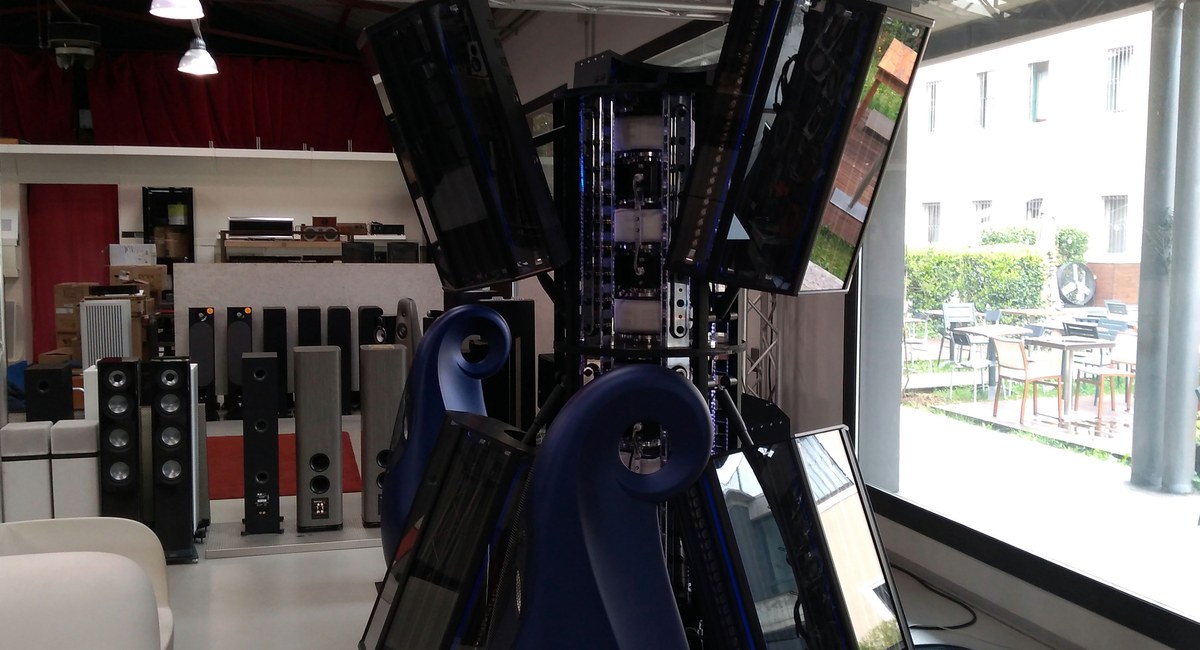
Opera One, completed in 1998, was the turning point. Pivetta had begun designing it in 1996, imagining an amplifier that was also a kinetic work of art.
At the time, amplifiers were generally compact devices shaped above all by their function. Pivetta imagined something completely different, a substantial creation with an artistic presence of its own.
The result was a cylindrical structure approximately one metre tall and almost 80 centimetres in diameter. A movement system opened it to a width of nearly two metres, revealing the architecture inside.
The audio function was integral to the project, but it did not define its full meaning. His ambition was to create a work of art in its own right that also performed a technological function.
Opera Only, a Monument That Opens
In 2011, Pivetta revisited the Opera One intuition with the ambition of taking it to a much larger scale. The result was Opera Only, a monumental kinetic sculpture completed in 2013.
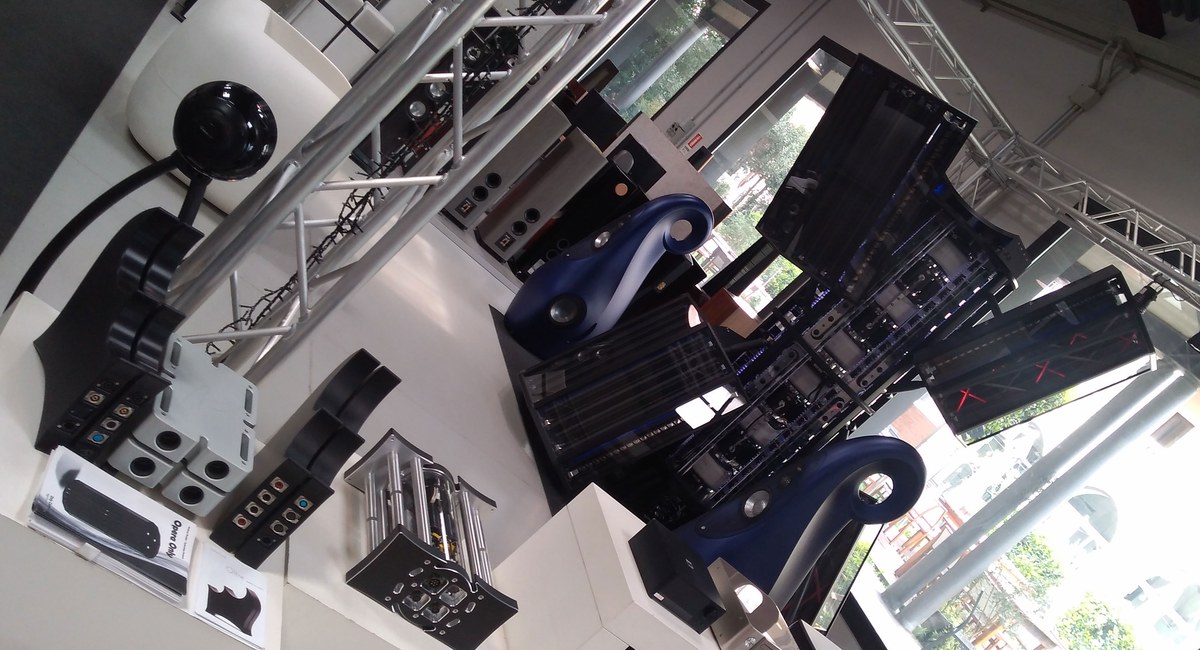
From the very beginning, he imagined a structure capable of opening and transforming. Movement was not a later addition but an essential part of the concept, and the opening also serves a practical purpose, including thermal management.
As it opens, the work reveals its internal architecture and the technological complexity that normally remains hidden. Pivetta wanted the instrument that creates music to become something to look at and experience in its own right.

A short film of the kinetic sequence shows the sculpture opening in stages. The project has evolved further since 2013 into an even more powerful configuration, while preserving its original identity.
OLTRE, an Open Visual Language
With OLTRE, Pivetta followed a different expressive direction. He wanted to create an open visual language that would not impose a single interpretation.
Its forms may evoke sea waves, a musical movement or even a fragment of a guitar. Pivetta does not want to dictate what the observer should see, and prefers to leave room for the imagination.
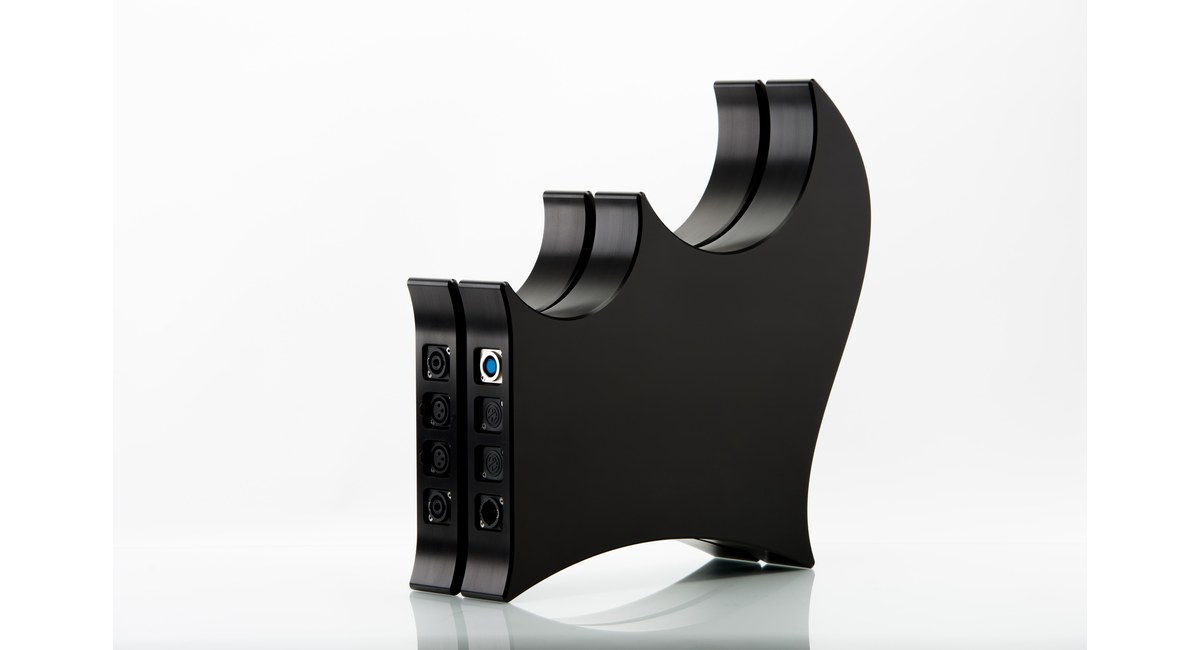
The aim was a work capable of prompting different interpretations and emotions while retaining its own identity. In OLTRE, music becomes a visual, sonic and emotional experience.
SILENTE, Electronics Inside Glass
SILENTE emerged from a more focused exploration of the relationship between electronics, vibration and resonance. Pivetta developed a stabilising nanofluid of his own conception, in which the entire electronic architecture is immersed.
The system is designed to help dampen micro-vibrations and isolate the components from unwanted structural resonances, within a highly controlled internal environment. The nanofluid also shields the components against electrical and thermal variation.
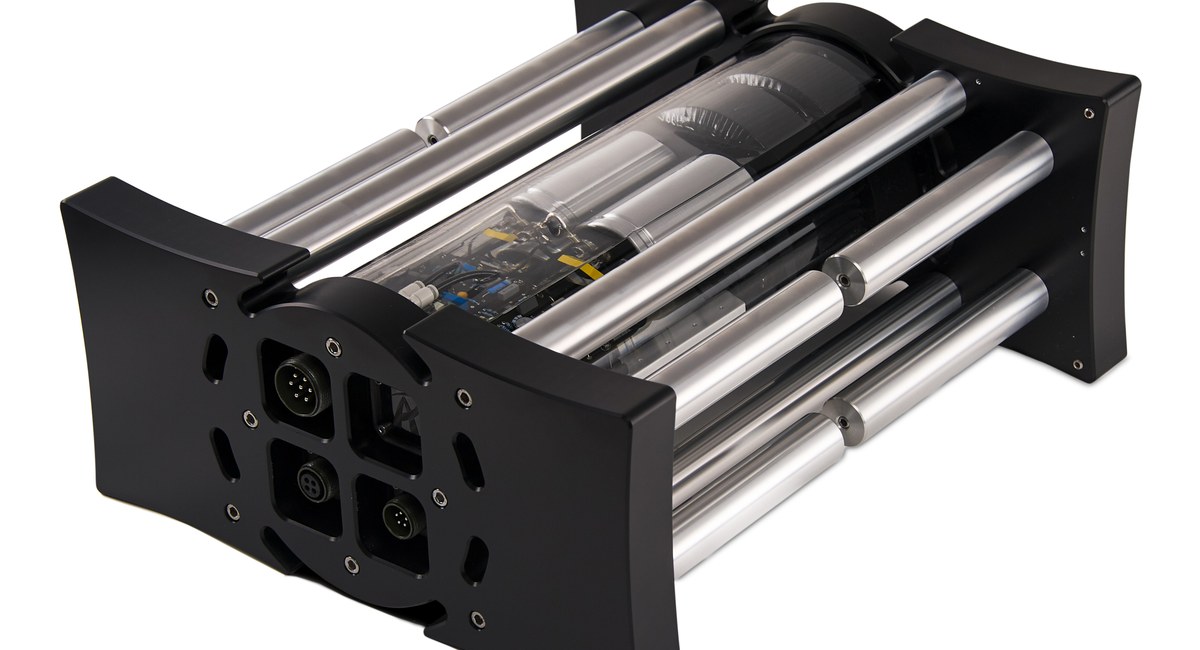
The choice of Murano glass has a precise meaning. It brings a distinguished Italian craft tradition into dialogue with contemporary technological research, and makes visible an architecture that would normally remain hidden.
The amplifier delivers 2 x 120 watts at 8 ohms, or 2 x 240 watts at 4 ohms, in a chassis of aircraft aluminium and Murano glass. Pivetta sees the research behind SILENTE reaching beyond audio, since principles related to the control of vibration and resonance may offer ideas for other technological and industrial fields as well.
Beyond Sound
Pivetta’s research extends beyond the world of sound. Over the years he has worked with mechanics, automation, design and the development of technological systems, including experiences related to the automotive sector.
One significant example dates back to 1989, when he developed the Jeep Dance project. It was a vehicle conceived to move without a driver on board, using radio-control systems and autonomous guidance.
Its control system was based on a Z80 microprocessor, conceived by Federico Faggin, who was born in Vicenza. The project was also presented on an Italian national RAI television programme.
The experience shows that his interest in innovation across different sectors goes back many years. For Pivetta, placing experience, innovation and design at the service of new ideas is a philosophy that reaches into fields including aerospace.
SYNERGY and a Resonant Future
Today, Pivetta is giving his journey a new dimension through SYNERGY, a professional initiative focused on collaboration with companies and brands. His role is that of a Creative and Technical Consultant, bringing creative vision, technical experience and inventive ability to new concepts and projects.
These collaborations may take the form of concept design, creative and technical consultancy, project development and licensing agreements. It is also an open invitation to international partnerships.
Among the projects he is developing is RPS, the Resonant Propulsion System. It is a research project under development, born from the interest in waves, frequencies and resonance that has accompanied him since he was fourteen.
RPS aims to explore a possible approach to propulsion based on wave physics and the principles of resonance. The research investigates perspectives that could be relevant to flight dynamics and space technologies.
SYNERGY and RPS represent two expressions of the same attitude. One puts his experience and inventive ability at the service of new collaborations, while the other continues to develop independent ideas and explore uncharted territory.
And yet, my spirit remains that of the child who wanted to understand how things worked: the curiosity to discover what does not yet exist and the desire to make it possible.
Andrea Pivetta, Designer and Inventor
After more than forty years, what continues to drive Pivetta is the same desire he had at the beginning. He does not consider what already exists as a limit, but as a starting point for imagining something new.



Leave a Reply