Inside Microsoft’s New Digital Innovation Center in Kuwait
Microsoft opened its Digital Innovation Center in Kuwait on 15 November. It is an adoption centre, not a data centre, and that distinction explains what it can and cannot do for the country's AI plans.

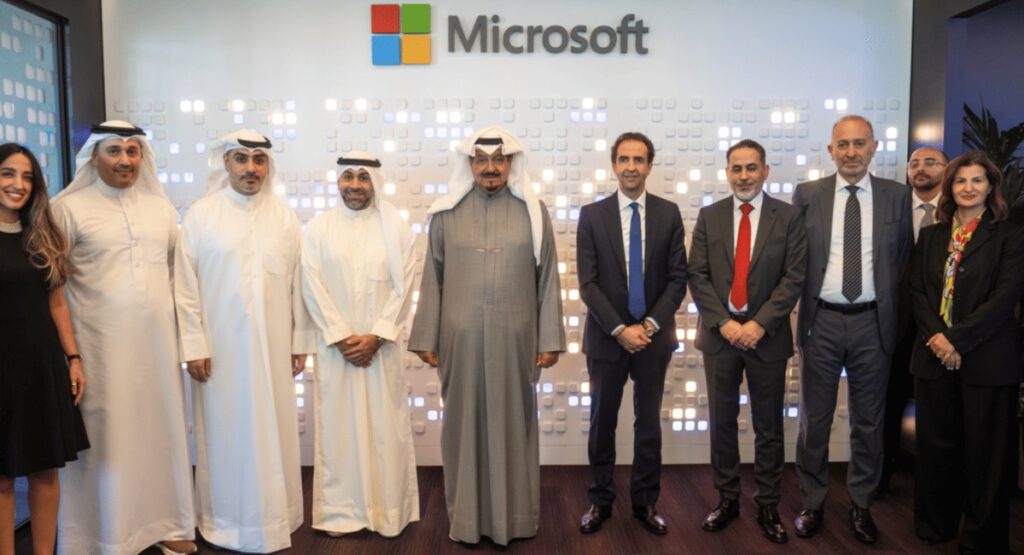
Microsoft opened its Digital Innovation Center in Kuwait on Sunday 15 November, with Prime Minister Sheikh Ahmad Abdullah Al-Ahmad Al-Sabah attending the inauguration. The centre, known as the MDIC, is a partnership between Microsoft and the State of Kuwait, built to support the country’s digital transformation under New Kuwait Vision 2035.
The first thing to understand about it is what it is not. It is not a data centre, and it adds no computing capacity to Kuwait.
It is an adoption centre, a place where government bodies, companies, startups, developers and students can try Microsoft’s AI, cloud and cybersecurity tools before committing to them.
That distinction is the story. Kuwait’s government is already rolling out AI across its departments, and the centre exists to turn that rollout from experimentation into everyday use.
The question it has to answer is whether a showcase and skills hub can do that job while the cloud infrastructure underneath it is still being built.
What the centre actually does
The MDIC offers workshops, technology demonstrations, open-house sessions, developer engagement and student programmes. Its audience is deliberately broad, covering government entities, customers, startups, developers and students.
Skills sit at the centre of the mission. The centre will support the Kuwait Skills initiative, run with the Central Agency for Information Technology, which trains government employees, students and developers in AI and cloud tools.
Microsoft’s own framing is that Kuwait is moving from AI experimentation toward trusted adoption at scale. The centre is designed for that next phase, where the work is less about showing what AI can do and more about getting organisations to use it properly.
Kuwait has a clear ambition to harness AI as a driver of economic growth, better public services and new opportunities for its people. The Microsoft Digital Innovation Center is about helping turn that ambition into action. By bringing together technology, expertise, skills and local partnerships, we want to help organizations move beyond experimenting with AI and start delivering meaningful impact at scale.
Naim Yazbeck, President, Microsoft Middle East and Africa
The timing is the story
The centre did not arrive before Kuwait’s AI rollout but in the middle of it. Kuwait Times reported that more than 40,000 Microsoft 365 Copilot licences had been activated across 79 government entities as of 9 November, a week before the opening.
The skills push is also already running. Microsoft said last year that the Kuwait Skills Programme would train more than 30,000 employees, 4,000 technical experts and 350 leaders in AI and cloud, and enable more than 100,000 users on Copilot through a Centre of Excellence built with the Central Agency for Information Technology.
Against those targets, the 40,000 licences look like a strong start rather than a finished job. The MDIC gives that programme a physical home and a place to show government teams what the tools can do in practice.

Twenty months from promise to opening
The centre is the delivery of a commitment Microsoft made in March 2025. In a strategic partnership agreement signed on 6 March 2025 with the Central Agency for Information Technology and the Communication and Information Technology Regulatory Authority, Microsoft said it intended to establish an AI powered Azure region in Kuwait and to give government employees access to Copilot.
The same agreement promised a Microsoft Technology Innovation Hub operating an AI Innovation Center, a Cloud Center of Excellence, a cybersecurity programme called Cybersphere and a comprehensive skilling initiative. The Kuwait Direct Investment Promotion Authority also approved the establishment of Microsoft Kuwait as a local entity.
Twenty months later, the Innovation Center part of that agreement now has an address. The Azure region part does not yet have a date.
Adoption first, infrastructure later
This is the honest gap in the story. Microsoft has still given no timeline for the Kuwait Azure region, and its published region list includes no region in Kuwait.
Azure workloads for Kuwaiti organisations are hosted in regions outside the country, such as Qatar Central and UAE North.
The contrast with Microsoft’s other Gulf markets is sharp. Its UAE regions have been running since June 2019, Qatar Central is live, and the Saudi Arabia East region in the Eastern Province opens to customers this month with three availability zones.
Kuwait is the last of the four countries in Microsoft’s regional framework to get local compute.
That order of events is not necessarily wrong. Skills and demand take time to build, and a region with no trained users and no workloads ready to move would sit idle.
But it does mean the centre’s users are trying AI tools that still run on infrastructure outside Kuwait, which matters for organisations with strict data residency requirements.
The opening of the Microsoft Digital Innovation Center represents an important step in Kuwait’s journey toward a knowledge-based, AI-powered economy. By strengthening collaboration between government, technology leaders and national talent, we are creating the environment needed to translate the potential of AI into tangible outcomes for our institutions, economy and people.
Omar Saud Abdulaziz Al-Omar, Minister of State for Communications and Information Technology, Kuwait
The ten billion dollar backdrop
The centre sits inside a much larger regional bet. In September 2026, Microsoft announced a Middle East framework under which it plans to invest more than 10 billion dollars in capital and operating expenditure across Kuwait, Qatar, Saudi Arabia and the UAE through 2030.
The plan includes more than 400 million dollars for subsea and land connectivity, including the SeaMeWe-6 cable with landing points in Qatar, Saudi Arabia and the UAE. Microsoft has not disclosed how the total will be split between the four countries.
For scale, Microsoft said in November 2025 that it expects to spend 15.2 billion dollars in the UAE alone between 2023 and 2029. It is also building sovereign cloud and AI infrastructure for Abu Dhabi with Core42.
Kuwait’s share of the regional framework is real but, for now, unquantified.
What success looks like, and what is missing
Microsoft has disclosed no investment figure for the centre, no size, no staff numbers and no programme calendar. That makes it hard to judge the scale of the commitment from the announcement alone.
The honest way to judge it is by what happens next. The markers to watch are the skills numbers, how deeply Copilot is actually used across those 79 government entities rather than just licensed, whether startups get real access to the centre, and above all the date of the Azure region.
The Digital Innovation Center reflects our long-term commitment to Kuwait. Our focus is not technology for technology’s sake. It is about working alongside government, businesses and our ecosystem to solve real challenges, build local capabilities and translate AI into meaningful outcomes for Kuwait.
Alaeddine Karim, General Manager, Microsoft Kuwait
What to watch
The Azure region announcement is the single biggest milestone ahead. Until it has a date, Kuwait’s AI adoption will keep running on infrastructure hosted elsewhere in the Gulf.
Demand is building from other directions too. Kuwait’s central bank issued its final open banking framework this month, which will push banks and financial technology companies toward cloud services and AI tools.
The centre will be one of the places they go to test them.
The centre’s real test is the one Microsoft set for itself. Moving organisations beyond experimenting with AI means showing measurable results in government services and businesses, not just running workshops.
The opening was the easy part.



Leave a Reply