FAB Posts 6% Rise in Q3 Profit to Dh5.74 Billion
First Abu Dhabi Bank reported a 6% rise in third-quarter net profit to Dh5.74 billion, from Dh5.39 billion a year earlier. Nine-month net profit reached Dh16.46 billion, up 3%.

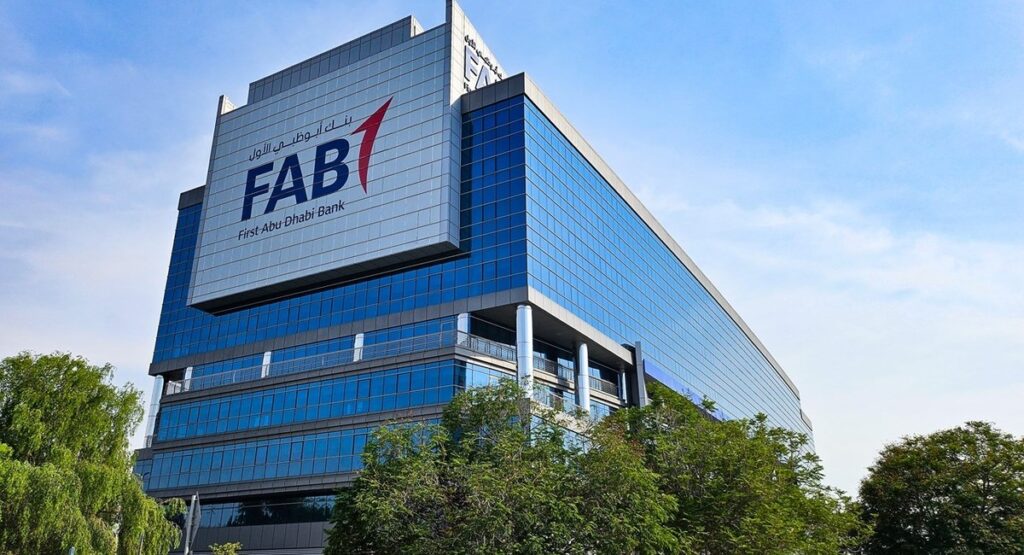
First Abu Dhabi Bank, the UAE’s biggest bank by assets, reported a 6% rise in third-quarter net profit. Net profit rose to Dh5.74 billion for the three months to September 30, from Dh5.39 billion a year earlier.
The Abu Dhabi-based lender reported the results on Thursday, October 29, in a statement to the Abu Dhabi Securities Exchange, where its shares trade. The quarter was largely unchanged from the previous quarter.
What drove the quarter
Net interest income rose nearly 7% year on year to Dh4.8 billion. Net fee and commission income increased 16% to Dh1.4 billion.
Operating income rose 9% year on year to Dh10.21 billion in the quarter. Operating profit increased 11% to Dh8.06 billion.
Profit before tax rose 9% to Dh7.01 billion.
FAB’s performance in the first nine months of 2026 reflects the strength of our franchise and the consistent execution of our strategy.
Hana Al Rostamani, Group Chief Executive Officer of FAB.
She also pointed to sustained growth across the bank’s businesses, the strength and scale of its diversified platform, and the continued expansion of its global franchise.
Nine-month performance
For the first nine months of 2026, net profit rose 3% to Dh16.46 billion. Operating income rose 7% to Dh29.71 billion, while profit before tax rose 5% to Dh20.22 billion.
Net interest income rose 11% year on year to Dh16.98 billion, driven by higher volumes and improved margins. Non-interest income rose 3% to Dh12.73 billion, accounting for 43% of operating income.
Return on tangible equity stood at 18.6%, above the bank’s medium-term guidance of more than 16%. That was lower than 20% in the same period last year.
Balance sheet and asset quality
Loans and advances grew 10% year to date to Dh679 billion. Customer deposits increased 5% year to date to Dh885 billion.
Total assets reached Dh1.47 trillion, up 7% since the start of the year. The non-performing loan ratio improved to 2.1%, from 2.6% a year earlier.
The Common Equity Tier 1 ratio strengthened to 14.0%. The Liquidity Coverage Ratio stood at 140% at the end of September.
Margins remained resilient, with NIM at 1.93%, up 5 basis points year on year, underpinned by our diversified business mix and structural funding advantage.
Lars Kramer, Group Chief Financial Officer of FAB.
He also said lending grew 10% year to date, driven by momentum across the bank’s wholesale and retail franchises.
The caution in the numbers
Net impairment charges reached Dh1 billion in the third quarter, from Dh850 million a year earlier. For the first nine months, they jumped 33% to Dh3.10 billion.
The bank linked the increase to a prudent approach to risk management amid an evolving risk environment.
Innovation, international and sustainable finance
International revenue rose 31% year on year, representing 22% of group revenue.
FAB said it scaled enterprise AI capabilities, with more than 6,000 employee-developed agents. It also became the first bank in the Middle East and Africa to execute live US dollar transactions at scale with Citi using tokenised deposits on Swift Ledger.
The bank said it has facilitated Dh417 billion in sustainable and transition financing, reaching 83% of its Dh500 billion target for 2030. It also set a Dh100 billion blue finance target in September, covering water and the blue economy from 2026 to 2035.
Why this matters
The growth is lending-led. Loans grew twice as fast as deposits year to date, so funding, not demand, is the number to watch next.
Fees are doing real work too. A 16% rise in fee and commission income in the quarter shows earnings are not relying on interest income alone.
Profitability is holding above guidance. Return on tangible equity of 18.6% remains above the bank’s target of more than 16%, even after easing from 20%.
Scale is also a buffer. A CET1 ratio of 14.0% and a liquidity coverage ratio of 140% give the bank room to keep lending while it provisions more cautiously.
What to watch in the fourth quarter is whether impairment charges keep rising, whether deposit growth catches up with lending, and whether the net interest margin holds near 1.93%.


Leave a Reply